Rocket League hitbox benchmark
We compared five hitbox presets in RocketSim, using matched starting conditions and search budgets within each test.
We have not reproduced these shot speeds in Rocket League.
| Preset | Ground-start flip | Carry and flick | No flip, approaching ball |
|---|---|---|---|
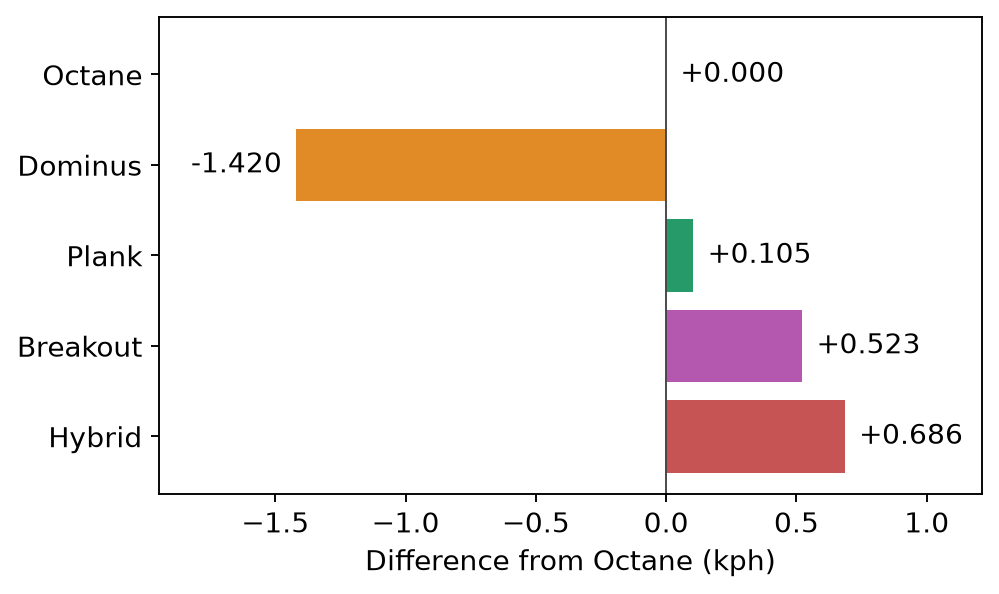
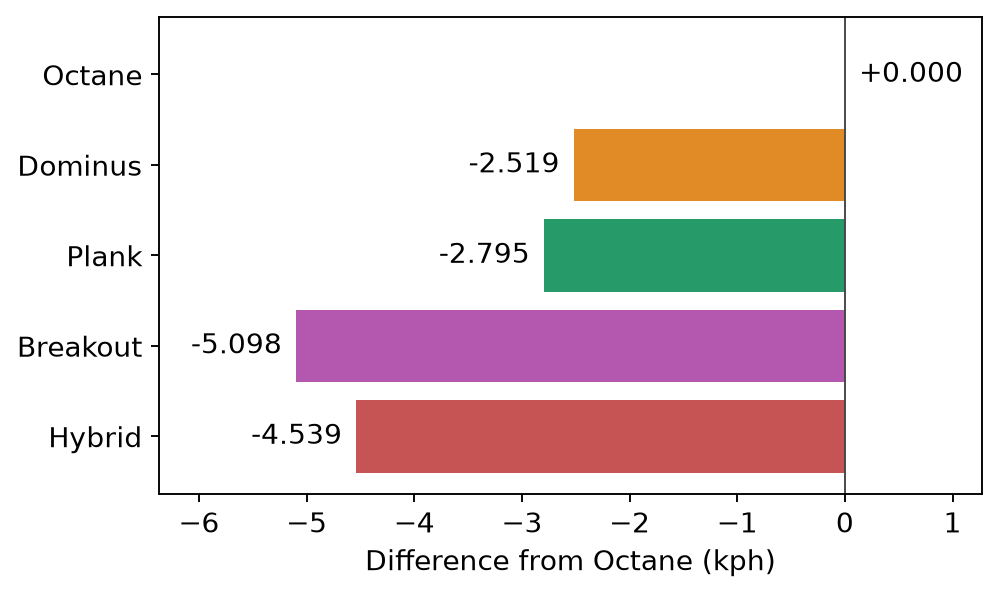
| Octane | 132.771 kph+0.000 kph vs Octane | 100.071 kph+0.000 kph vs Octane | 117.576 kph+0.000 kph vs Octane |
| Dominus | 131.351 kph-1.420 kph vs Octane | 97.553 kph-2.519 kph vs Octane | 117.975 kph+0.399 kph vs Octane |
| Plank | 132.876 kph+0.105 kph vs Octane | 97.277 kph-2.795 kph vs Octane | 118.015 kph+0.439 kph vs Octane |
| Breakout | 133.294 kph+0.523 kph vs Octane | 94.974 kph-5.098 kph vs Octane | 118.067 kph+0.491 kph vs Octane |
| Hybrid | 133.457 kph+0.686 kph vs Octane | 95.533 kph-4.539 kph vs Octane | 117.506 kph-0.069 kph vs Octane |
Pre-clamp hits. We measured incoming car speeds up to 99.598 kph on the dodge tick, before RocketSim applies its 82.8 kph car cap. These peaks depend on that timing. Methods and later-contact controls.
We report no-flip search winners and include matched-sequence transfers for the flip tests. Compare presets within a column: we used different starting conditions across tests.
- Ground-start flip: Car starts at 64.8 kph; ball falls from 3 m.
- Carry and flick: Car and ball start at 43.2 kph; carry before jumping.
- No flip, approaching ball: Car starts at 82.8 kph; ball approaches at 36 kph.
Fennec, Harbinger and Scarab share Octane physics. The 2016 Batmobile uses Plank. Hybrid appears as a preset.
Differences from Octane
Ground-start flip
Carry and flick
Winning sequences
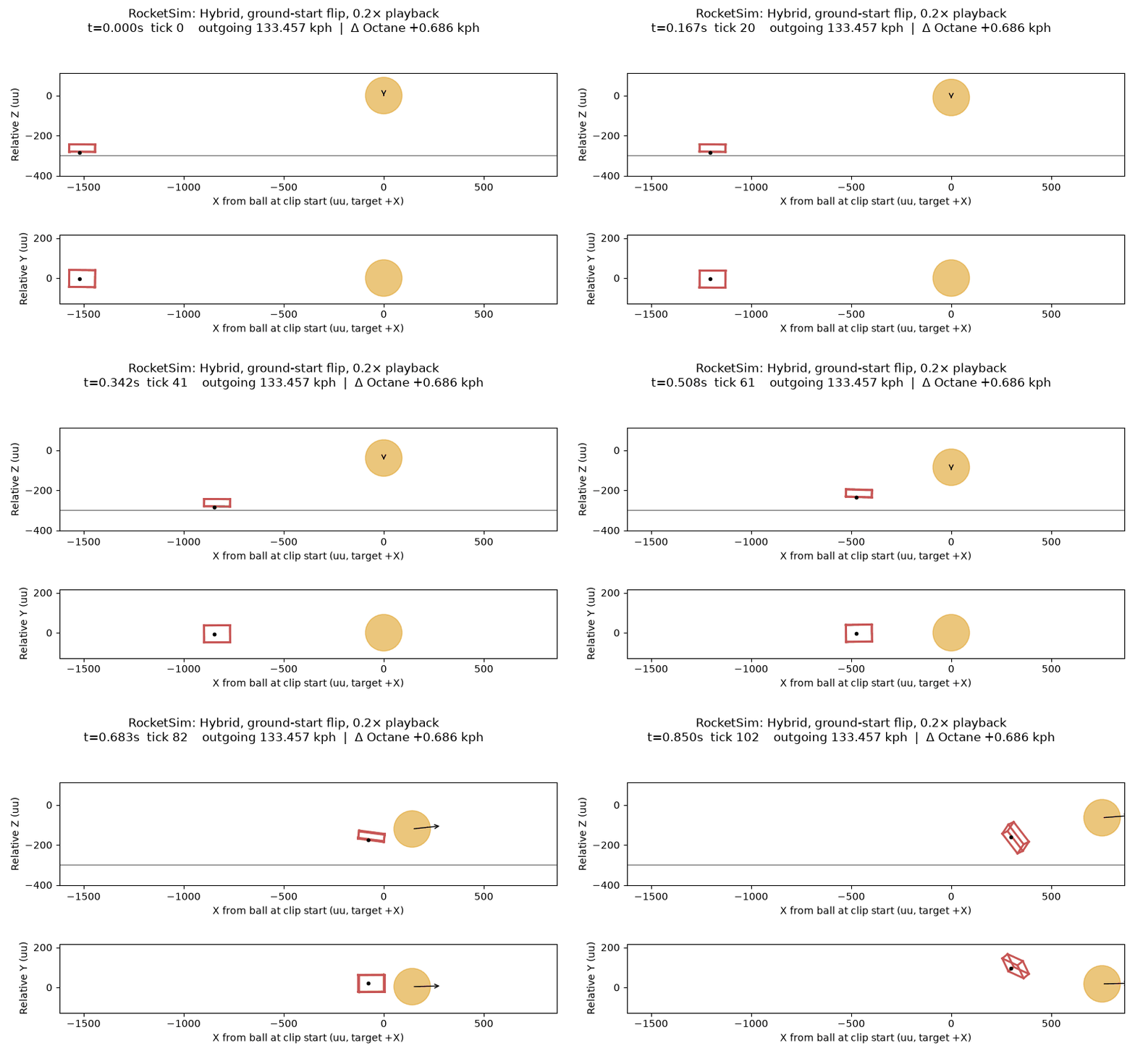
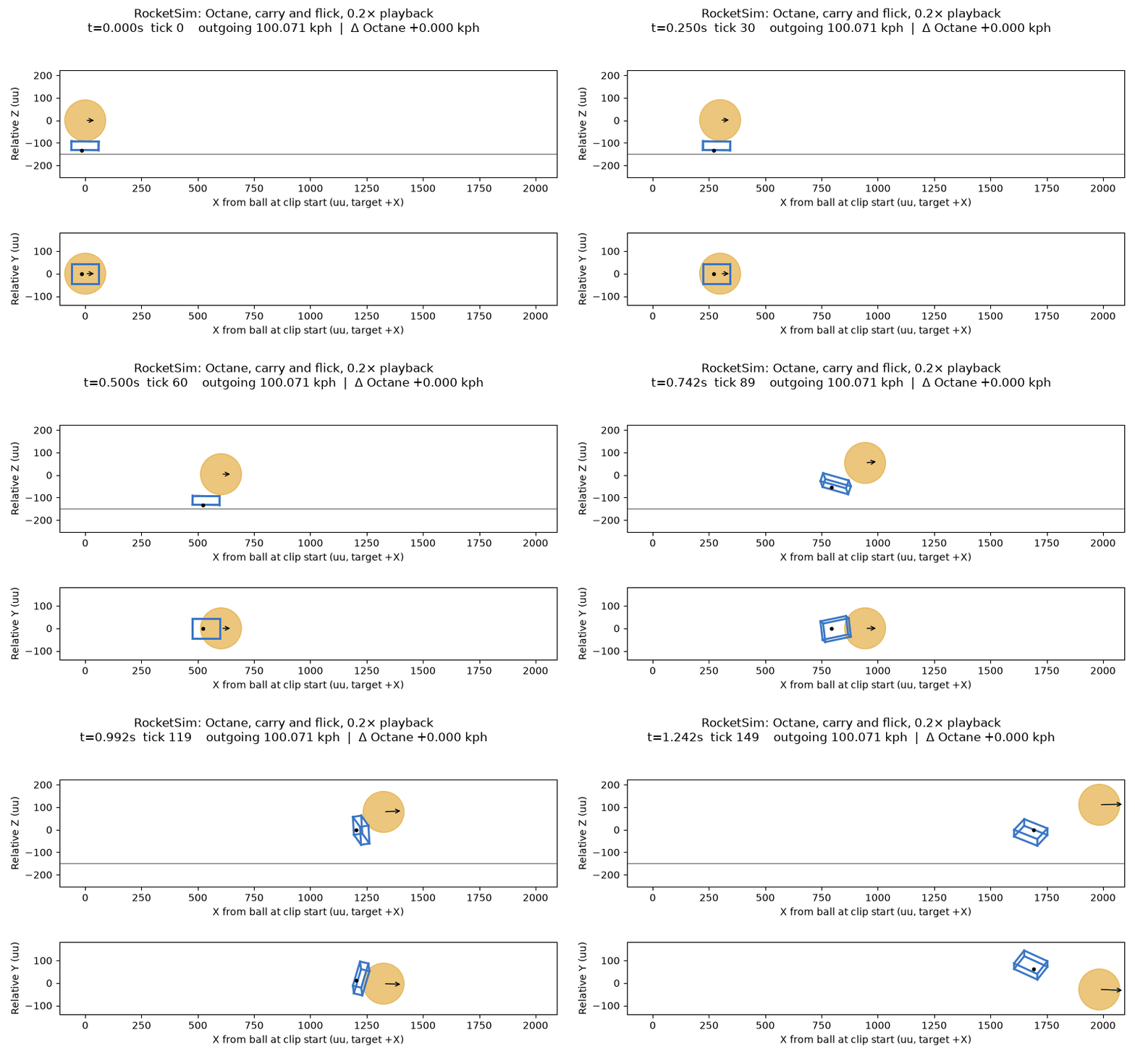
View every preset and download its inputs.
Other controls and contact timing
| Preset | No flip, stationary ball | Airborne dodge | Ground flip, later contact |
|---|---|---|---|
| Octane | 116.386 kph+0.000 kph vs Octane | 128.301 kph+0.000 kph vs Octane | 116.924 kph+0.000 kph vs Octane |
| Dominus | 116.431 kph+0.045 kph vs Octane | 131.492 kph+3.191 kph vs Octane | 119.014 kph+2.091 kph vs Octane |
| Plank | 116.436 kph+0.050 kph vs Octane | 132.330 kph+4.029 kph vs Octane | 118.925 kph+2.002 kph vs Octane |
| Breakout | 116.440 kph+0.054 kph vs Octane | 132.448 kph+4.147 kph vs Octane | 117.852 kph+0.928 kph vs Octane |
| Hybrid | 116.354 kph-0.032 kph vs Octane | 128.425 kph+0.124 kph vs Octane | 119.536 kph+2.612 kph vs Octane |
RocketSim keeps the stationary-control ball asleep until contact. The airborne-dodge winners hit on the dodge-input tick. For the later-contact column, we selected shots from the grounded search with contact at least two ticks after dodge and incoming car speed at or below the normal cap. We did not run a separate optimization for that subset.
We searched 162,000 candidates with equal budgets across presets within each test, then checked transfers and execution errors. A larger search may find faster shots. Methods · Measurements and validation